Roland D50 Vst Plugin
As plug-ins. compatible with AU, VST, and the long-awaited AAX format, each synthesizer can be used in the various production environments found in Mac / Windows. Add flair to your music composition with a variety of timeless, legendary sounds. Only supports 64-bit plug-ins. With the new Roland D-50 DCB Software Synthesizer, Roland Cloud subscribers can have the iconic sound of LA in a powerful plugin, which perfectly recreates this legendary synth down to the subtlest of nuances! Roland – VS D-50 VST Latest Free Download Particularly, And work with the windows 32 Bit (x86) / 64 Bit (x64). Yes, It is an Offline Installer / Full Standalone Setup. To run this app 1 GB of RAM required. VST 4 FREE - Free Audio Plug-ins and Archives. Free VST downloads: Juno 6 (Juno-6 emulation by Open Source VSTi) - June-21 (Roland Juno / MKS-50 emulation by mikerodd) - RMI Harmonic (Vintage. UVI Digital Synsations - 4 instruments traverse the revolutionary sounds of 1990's digital synths including the Korg M1, Ensoniq VFX, SY77 and D50. Retro Boy VST Plug-In is a virtual analog chiptune synth/emulator. Chiptune or otherwise known as 8-bit music is music or sounds synthesized by the sound chip of computers, video game systems, and most handled gaming systems. Retro Boy VST Plug-In features a single oscillator that has seven waveshapes: 12.5% pulse, 25% pulse,%50 pulse, saw. Satellite Free VST is a free and exclusive VST/AU/RTAS Plug-In Instrument. Using 'roland d50 vst' crack, key, serial numbers, registration codes is illegal. The download file hosted at publisher website.
You may have seen our exclusive video of the new Roland D-05 from Knobcon 2017, it seems there is a lot of love for the classic Roland D50 synth.
You may not be aware but Roland is giving users the opportunity to try the official Roland D50 Plug-in for 30 days for free.
Roland says this about the new D50 synth; /delay-lama-vst-plugin.html.
'Released thirty years ago in 1987, the Roland D-50 Linear Arithmetic (LA) Synthesizer is easily one of the most influential keyboards ever made. The D-50 helped to define the sound of the late 80’s with its instantly recognizable mix of sampled attacks and synthesized sustaining waveforms (that’s LA!) plus chorus, reverb, and EQ. It’s the basis of classic tracks in a wide range of genres including Synth Pop, New Wave, New Jack and R&B, plus countless film scores.
With the new Roland D-50 DCB Software Synthesizer, Roland Cloud subscribers can have the iconic sound of LA in a powerful plugin, which perfectly recreates this legendary synth down to the subtlest of nuances!
- Perfect recreation of D-50 from the company that made the original
- Digital Circuit Behavior (DCB) faithfully captures every detail
- Authentic user interface with all original controls and parameters (including those found on the sought-after Roland PG-1000 hardware programmer!)
- All the original presets plus fresh new sounds
- 64-bit VST2, VST3 and AU support
- Simple installation and updates via Roland Cloud Manager
Try The Official Roland D50 Plug-in For 30 Days For Free
Roland is offering a 30 day trial of the Roland Cloud, which if you continue to use at $19.95 per month gives you access to a vast range of Roland synths. Even better if you keep your subscription active for the year then you get a plug-in of your choice free each year.
Vst Plugin Free Download
| Roland D-50 | |
|---|---|
| Manufacturer | Roland Corporation |
| Dates | April 1987-1990 |
| Price | $1,895 US £1,445 GBP ¥238,000 JPY |
| Technical specifications | |
| Polyphony | 16 voices, 8 voices (Dual or Split mode) |
| Timbrality | 2-part |
| Oscillator | 32 partials with 2 per voice; 4 per voice in Dual or Split mode |
| LFO | 3 |
| Synthesis type | DigitalSample-basedSubtractive (Linear Arithmetic) |
| Filter | low-pass resonant filter referred to as a Time Variant Filter (TVF) |
| Attenuator | ADSR envelope referred to as Time Variant Amplifier (TVA) |
| Aftertouch expression | Yes |
| Velocity expression | Yes |
| Storage memory | 64 patches |
| Effects | reverb, chorus, EQ |
| Input/output | |
| Keyboard | 61 keys |
| Left-hand control | Pitchbend / modulation lever |
| External control | MIDI in/out, pedal switch, pedal hold, EXT Control, EXT Pedal |
The Roland D-50 is a synthesizer produced by Roland and released in April 1987. Its features include subtractive synthesis, on-board effects, a joystick for data manipulation, and an analogue synthesis-styled layout design. The external Roland PG-1000 (1987-1990) programmer could also be attached to the D-50 for more complex manipulation of its sounds. It was also produced in a rack-mount variant design, the D-550 (1987-1990), with almost 450 user-adjustable parameters.[1]
The D-50's capabilities could be modified through the addition of third-party products by Musitronics, most notably the M-EX which made the D-50 multitimbral (the D-50 was bi-timbral) and expanded the patch memory, as well as a chip that improved the D-50's response to incoming MIDI commands and a system for burning custom PCM cards with user samples for playback in the D-50.[2]
The D-50 was used in popular music by many artists including Jean-Michel Jarre[3], Prince[4], Sting, Michael Jackson and Enya.[5]
History[edit]
The D-50 was the first affordable synthesizer to combine sample playback with subtractive synthesis. The engineers at Roland determined that the most difficult component of an instrument's sound to simulate realistically is the attack. To better emulate realistic sounds, the D-50 included almost 100 attack samples in ROM. The synthesizer played back an attack sample which was dove-tailed with more conventional subtractive synthesis to create the sustain of the sound. This dual-use method was required in 1987 since RAM was so expensive. Roland did, however, incorporate a number of 'texture' samples that could be mixed into the synthesized sustain-part of a patch. These sustain samples gave many D-50 patches a lush and airy quality.
The Roland D-50 was awarded a TEC Award for outstanding technical achievement in musical technology in 1988.[6]
Technology[edit]
Although the D-50 was among the first non-sampling machines to be able to produce sounds with sample-based characteristics, it was not long before many synthesizers on the market began using similar methods to create sounds. Roland later released a series of lower-priced keyboards and modules that allowed musicians who couldn't afford the relatively expensive flagship D-50 to have some of these sounds (Roland D-10 (1988), D-110 (rack version of D-10) (1988) D-20 (1988), D-5 (1989), MT-32). Though these lower priced D-series synthesizers did not contain the full 'LA' synth engine, each was 8 part multi-timbral, and Roland doubled the number of onboard PCM samples. Roland also produced the 76-key, 6-octave 'Super-LA' D-70 (1989-1990). With the D-70 Roland removed the digital synthesis section, which was replaced with full-length, more realistic and natural sounding samples, including an acoustic piano, which the D-50 lacked. The D-70 also had an expanded filter and effects section and was 5 part multi-timbral. Even with its improvements, however, the D-70 was unable to catch up with the dominant workstation of the time—the Korg M1—and failed to become the next Roland flagship synthesizer.
Roland D50 Vst Plugin Download
The D-50 produces a hybrid 'analog/digital' sound: one can use traditional analog waveforms like saw, square and sine together with PCM samples of actual acoustic instrument attack transient, filtered through analog processing (LFOs, TVFs, TVAs, ring modulator, effects, etc.). This breakthrough led to the creation of totally new sounds never done before on either purely analog synths or digital samplers.
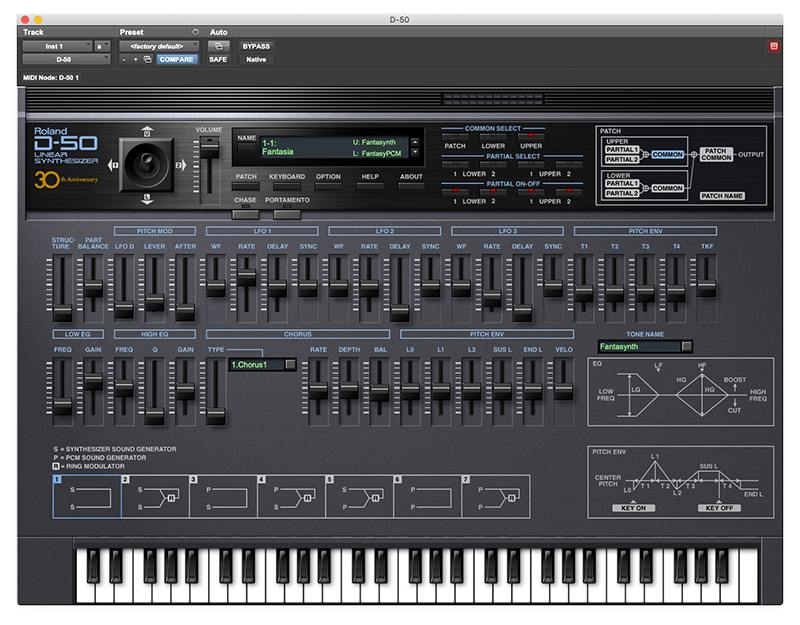
Each D-50 sound ('patch') was made up of 2 'tones' (Upper and Lower) and each tone was made up of 2 'partials'. Each partial could be either a 'analog waveform' (pulse, sawtooth or sine waveform) and a VCF or a digital PCM waveform (sampled attack transient or looped sustain waveform). The partials could be arranged following 1 of 7 possible 'structures' (algorithms), with a combination of either a PCM waveform or synthesized waveform, with an option to ring-modulate the two partials together. The synthesized waveforms could be pulse-width modulated and passed through an analog 4-stage Low-Pass filter, allowing for subtractive synthesis. The lower and upper part could be split or played in dual on the keyboard. The dual configuration allows an 8-voice polyphony bi-timbrality while only one partial plays, which allows for 32 voices.[7]
Not only was the synthesis method new; the D-50 was arguably the first commercial synthesizer to include digital effects such as chorus and reverb, adding to the characteristically bright, rich, lively and sometimes realistic sound, featured on countless records of the period. Each of those effects had 10+ variations with editable parameters usually found in dedicated rack effects processors rather than keyboard synths. It was also on the forefront of the change of the look of a typical keyboard player on stage: instead of being surrounded with multiple instruments, with more versatile instruments and the continued adoption of the MIDI standard, they were starting to appear with only one or two keyboards, typically a D-50 with either Yamaha DX7 or Korg M1.
The D-50 was fully MIDI-compatible, though it transmits on only one channel. The keyboard was velocity- and after-touch-sensitive, and the keys were slightly 'weighted' with metal for a higher-quality feel. It included 64 patches on-board, and 64 more patches were available on the expansion RAM card that was included. It uses a CR2032 lithium battery for memory backup.
For its sound and build quality, and the unique synthesis method it featured, the D-50 has remained popular to this day. Its synthesis engine, in more or less updated forms, was used in Roland's JV and XP series synths, among others. Furthermore, in 2004, Roland released a VC-1 expansion card for V-Synth and VariOS synthesizers. It contained a modeled and updated D-50 synthesis engine and the original operating system, including factory- and all Roland 'expansion cards' patches. Since the newer DAC chips sounded 'cleaner' with less noise output and overall higher bit and sample rates, it included the option to simulate the D-50's 'rougher' output.
The D-550 is a rack-mount version of D-50, with fewer front panel controls, no joystick and sliders. It employs the same sound circuitry (the main circuit board is exactly the same in both, labeled 'D-50/D-550')
Legacy[edit]
The D-50 was introduced in 1987 as the popularity of the Yamaha DX7 was declining, resulting in the D-50 being the most popular synthesizer on the market until the introduction of the Korg M1 the following year.[8] The D-50's synthesizer-on-top-of-samples-and-through-effects innovation was an influence on the M1, which went on to become Korg's top selling keyboard, until the release of the Korg Triton. In fact, this scheme was a common method of digital keyboard sound creation for more than a decade, until ROM and Flash RAM were finally inexpensive enough to store entire samples or multisamples.
The presets of the D-50, authored by Eric Persing and Adrian Scott, were well received by the artists' community, and most of them can be heard on numerous commercial albums of the late 1980s. The D-50's factory presets have enjoyed a long legacy, as patches like 'Digital Native Dance', 'Staccato Heaven', 'Fantasia', 'Pizzagogo', 'Glass Voices', and 'Living Calliope' are so common that they border on cliche. Some other D-50 presets live on in every machine that conforms to the General MIDI specification, including 'Fantasia' (alternatively called 'New Age Pad'), 'Soundtrack', 'Atmosphere', and 'Nylon Atmosphere'.[1]
The Roland V-Synth and V-Synth XT can load a card which emulates the D-50. In this mode, they copy the D-50 almost perfectly, although they lose the more sophisticated V-Synth capabilities.
On September 8, 2017, Roland announced the Roland D-05, a miniaturized version of the D-50, as part of their Boutique series. The instrument includes the original presets of the D-50, plus all of the ROM expansions Roland created for it. The instrument was released in October 2017.[9]
Also in 2017, Roland released a VST plugin version of the D-50.[10] via their Roland Cloud website.
Roland Vst Plugin
See also[edit]
Roland D50 Vst Cracked
References[edit]
Roland D50 Free
- ^ ab'Roland D50'. July 1997. Archived from the original on 6 June 2015.
- ^Mark Vail, Vintage Synthesizers, Miller Freeman, 1993, p. 63
- ^'D-50 famous examples'.
- ^'Roland D-50'. Guitarcloud - Prince Equipment Archive.
- ^'Roland reissues classic D-50 synth for its 'Boutique' line'. September 9, 2017. Retrieved 2020-08-02.
- ^1988 TEC Awards
- ^Julian Colbeck, Keyfax Omnibus Edition, MixBooks 1996, p. 97-100
- ^Mark Vail, Vintage Synthesizers, Miller Freeman, 1993, p. 251
- ^Chords, KeyboardMag.com Online Community for Keys, Boards, Gear, Lessons, News, Video, Tabs &. 'Roland Announces D-05 Linear Synthesizer'. Retrieved 2017-10-14.
- ^https://www.rolandcloud.com/catalog/legendary/d-50